Metadata
aliases: []
shorthands: {}
created: 2022-02-27 22:13:59
modified: 2022-02-27 22:33:56
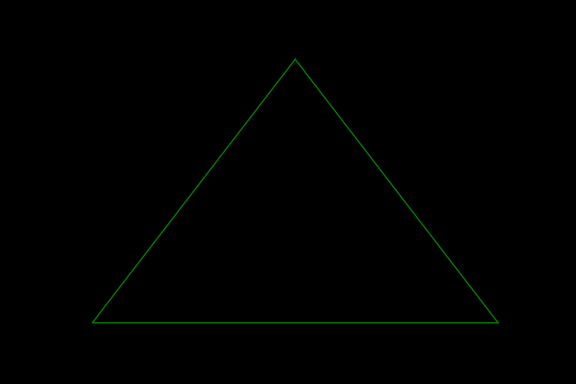
Triangle subdivision creates
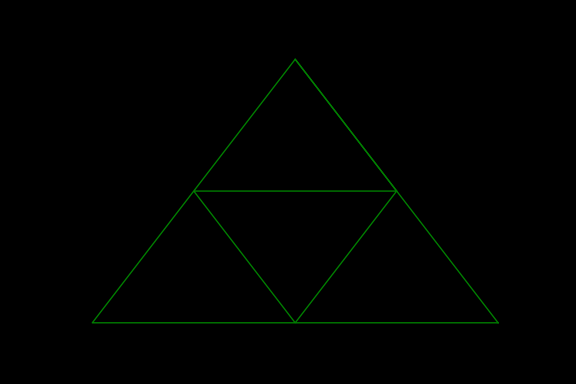
The small triangles are created by finding the halving points of the sides of the original triangle, then:
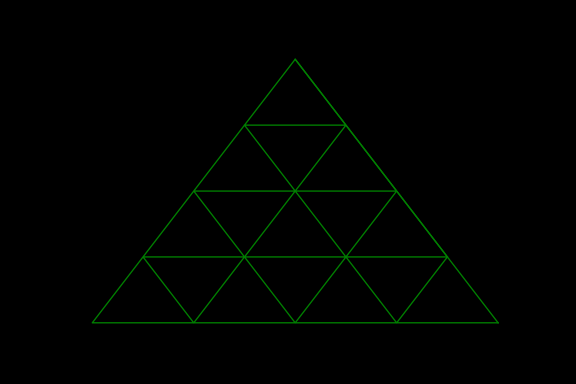
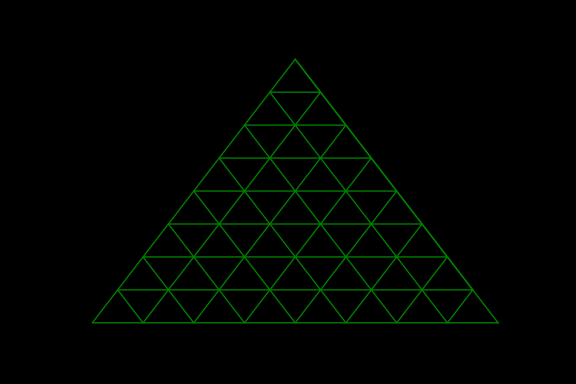
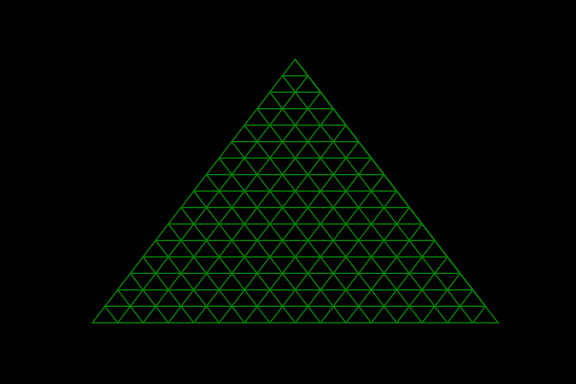
The method can be done multiple times of course. These figures show an example, done on a single triangle:
The method can be done on triangle meshes as well. Possible use cases:
This algorithm works with the convention of storing the vertex coordinates and indices in separate arrays and is written in Python. The function does multiple passes (determined by the steps argument) by default. Also, this method is not very efficient with memory
def subdivide_triangles(x, y, z, i, j, k, steps = 4):
    # Create temporary arrays
    x_out = []
    y_out = []
    z_out = []
    i_out = []
    j_out = []
    k_out = []

    for step in range(steps):
        # For every face (traingle), we insert four subtriangles here
        for face in range(len(i)):
            # Calculate halving points into tuples
            half1 = ((x[i[face]] + x[j[face]]) / 2.0, (y[i[face]] + y[j[face]]) / 2.0, (z[i[face]] + z[j[face]]) / 2.0)
            half2 = ((x[j[face]] + x[k[face]]) / 2.0, (y[j[face]] + y[k[face]]) / 2.0, (z[j[face]] + z[k[face]]) / 2.0)
            half3 = ((x[k[face]] + x[i[face]]) / 2.0, (y[k[face]] + y[i[face]]) / 2.0, (z[k[face]] + z[i[face]]) / 2.0)

            # Store corner points in tuples
            p1 = (x[i[face]], y[i[face]], z[i[face]])
            p2 = (x[j[face]], y[j[face]], z[j[face]])
            p3 = (x[k[face]], y[k[face]], z[k[face]])
            # Append the vertices to the vertice arrays, in a fixed order
            x_out.extend([p1[0], p2[0], p3[0], half1[0], half2[0], half3[0]])
            y_out.extend([p1[1], p2[1], p3[1], half1[1], half2[1], half3[1]])
            z_out.extend([p1[2], p2[2], p3[2], half1[2], half2[2], half3[2]])

            plen = len(x_out)

            # Append the indices for the four new triangles
            # The indices are at the end of the vertex arrays, so
            # we subtract from the length of the array
            i_out.extend([plen-6, plen-3, plen-3, plen-2])
            j_out.extend([plen-3, plen-2, plen-5, plen-4])
            k_out.extend([plen-1, plen-1, plen-2, plen-1])

        # Copy the subdivided mesh to the original variable names
        x = [*x_out]
        y = [*y_out]
        z = [*z_out]
        i = [*i_out]
        j = [*j_out]
        k = [*k_out]
        # Reset temporary
        x_out = []
        y_out = []
        z_out = []
        i_out = []
        j_out = []
        k_out = []

    return x, y, z, i, j, k
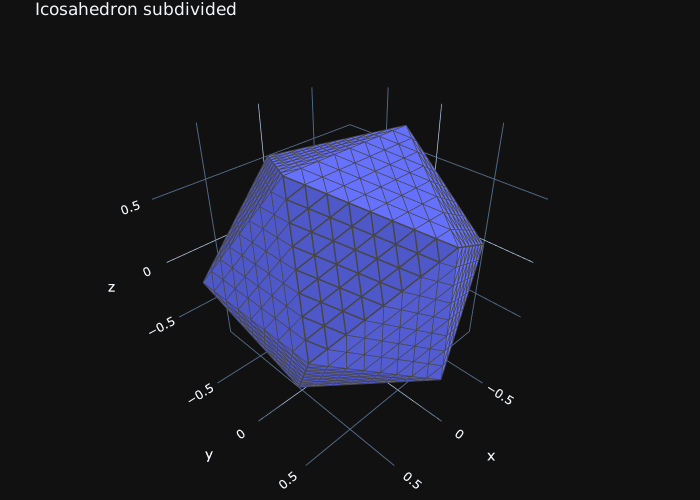
This algorithm transforms this icosahedron:
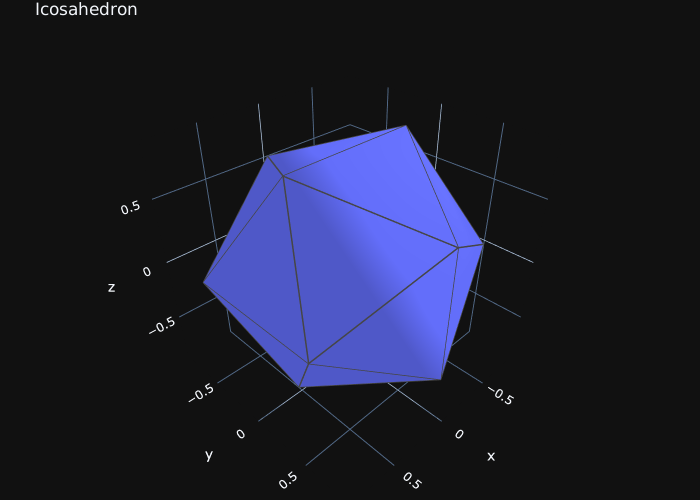
Into this (with step = 3):